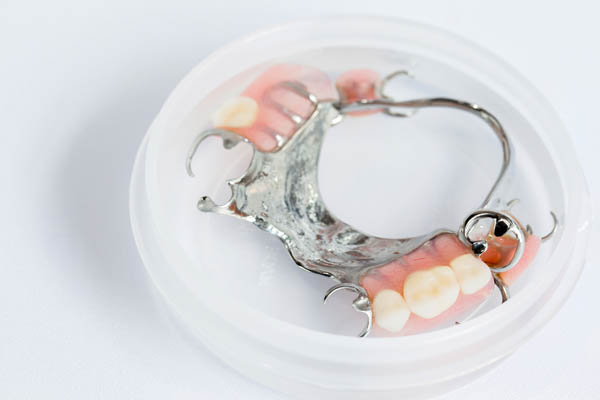
Partial dentures can be an affordable way to replace missing teeth. They can restore your smile, and they cost significantly less than alternatives like implants or dental bridges.
Dentists typically recommend partial dentures when a patient has only lost some of their teeth. However, complete denture sets are recommended for those who have lost most of their natural teeth.
Replacing missing teeth with partial dentures does not require any invasive procedures, and your artificial teeth can be ready in as little as two weeks. The oral prosthetic can close up the gaps in your smile and restore the function of your lost teeth.
Getting used to life with partial dentures
Partial dentures can take time to get used to, particularly when it is time to eat. Having an artificial object in the mouth can feel awkward, so expect to go through an adjustment period to learn how to speak and eat with the prosthesis. Here are a few tips on how to eat with partial dentures and foods to avoid.
1. Taking your time
Trying to eat with partial dentures is different from eating with real teeth. But taking the time to learn to eat with artificial teeth is all a part of the process.
Most people do not have to think much about chewing food with natural teeth because the nerves inside them send signals to the brain, signaling how hard to chew. However, the artificial teeth attached to partial dentures are not connected to the brain, making it harder to gauge how hard to chew food. Patients should stick with soft foods like cereals, fish, vegetables, potatoes, and eggs when they first start wearing partial dentures.
2. Avoiding biting with the front teeth
Biting down with artificial teeth at the front of the mouth can cause damage to the oral prosthetic, and it typically feels awkward. It is better to cut things down into smaller sizes that can be placed in the mouth and chewed.
Foods to avoid when wearing partial dentures
Some foods are harder to break down with artificial teeth, and trying to force the issue can lead to the prosthesis becoming damaged. Common foods that patients should stay away from when wearing partial dentures include:
- Nuts: Hard foods like almonds and peanuts can easily damage the artificial teeth attached to partial dentures
- Steaks: This can be tough for some people to avoid, but chewy foods like steaks put stress on the dentures and jaw, leading to pain and discomfort
- Hard candy: Avoid biting down on these at any cost because they can damage partial dentures
- Foods with tiny bits: Foods like popcorn can easily get stuck between artificial teeth, damaging them
Explore partial dentures
Partial dentures might be the right solution for you if you are missing a few teeth. Give us a call or visit our Murfreesboro clinic to set up a consultation with our dentist.
Request an appointment here: http://www.drmccawley.com or call James R McCawley DDS at (615) 526-2497 for an appointment in our Murfreesboro office.
Check out what others are saying about our dental services on Yelp: Partial Dentures for Back Teeth in Murfreesboro, TN.
Recent Posts
Are you tired of loose dentures or tooth loss that impacts your daily life? All-on-4 implant treatment from a restorative dentist provides a permanent solution to restore your smile. Missing an entire arch of teeth changes everything from speaking to chewing and eating. Fortunately, modern restorative dentistry provides a straightforward way to a healthy and…
Most people grow up hearing that dental care means one checkup with a family dentist every six months. While that schedule works well for many patients, it is not the right fit for every smile. Some people benefit from more frequent visits because their oral health needs, habits, or medical history place them at a…
Searching for "dentist near me" offers more than just choosing a provider based on location convenience. The right general dentist provides the essential care necessary to keep a smile healthy and vibrant while protecting the foundation of the teeth and gums. Daily habits like brushing and flossing help maintain oral health, but certain areas remain…
Dental veneers can improve the shape, color, or symmetry of the smile in a way that looks natural. These thin restorations are bonded to the front of the teeth to enhance appearance while maintaining a natural feel. Available in both composite and porcelain materials, veneers are selected based on aesthetic goals, treatment timeline, and lifestyle.Composite…